How Each Marking Technology Works

Before we compare them, you need to understand what’s actually happening at the material surface.
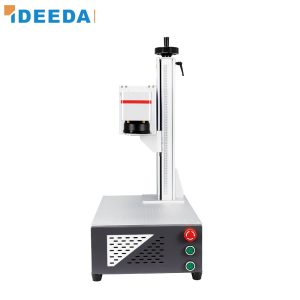
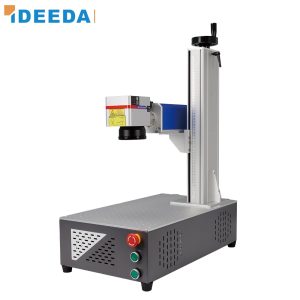
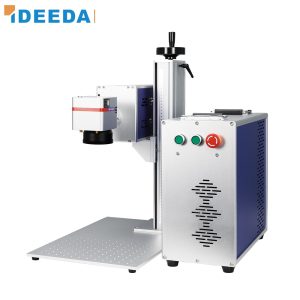
Laser Marking
A focused laser beam interacts with the material surface through one of four mechanisms:
- Annealing (surface oxidation): The laser heats the metal surface without removing material, producing a color change (typically black on stainless steel). No depth — the mark is flush with the surface.
- Etching (surface removal): The laser vaporizes a thin layer of material, creating a shallow groove. Depth: 0.01–0.05mm.
- Engraving (deep removal): Higher power and slower speeds remove more material. Depth: 0.05–0.5mm.
- Foaming/color change: On plastics and some coated metals, the laser causes a chemical or structural change that produces contrast without material removal.
Key characteristic: Non-contact. The laser beam never touches the part. No mechanical force, no tool wear, no consumables.
Dot Peen Marking
A pneumatically or electromagnetically driven stylus (typically carbide or diamond-tipped) rapidly strikes the material surface, creating a series of small indentations (dots). These dots are arranged to form text, numbers, logos, or DataMatrix codes.
Key characteristic: Contact-based. The stylus physically impacts the surface, creating permanent deformations. Depth: 0.05–0.5mm, depending on material hardness and impact force.
Inkjet Marking
A printhead sprays tiny droplets of ink onto the material surface. Two main types:
- Continuous Inkjet (CIJ): A continuous stream of charged ink droplets is deflected by electric fields to form characters. Used on fast production lines.
- Drop-on-Demand (DOD): Ink droplets are ejected only where needed. Used for larger characters and slower lines.
Key characteristic: Additive and non-permanent. The ink sits on the surface and can be removed by abrasion, solvents, or environmental exposure unless specially formulated and cured.