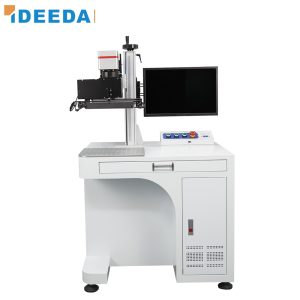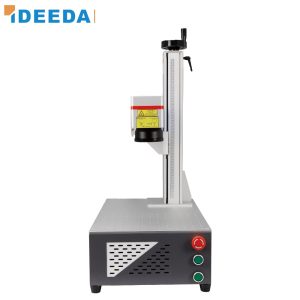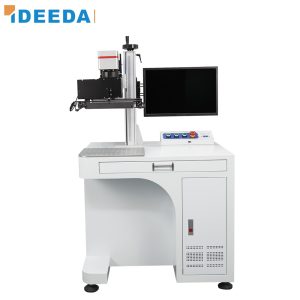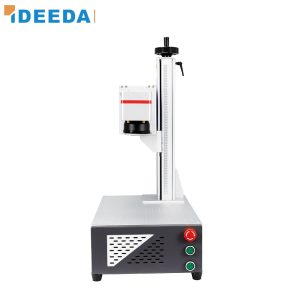
20W Fiber Laser: The Workhorse for Surface Marking

Let’s start with the most popular option, and for good reason.
What 20W Does Best
A 20W fiber laser is the Swiss Army knife of metal marking. It excels at annealing marks — the dark, permanent marks created on stainless steel, chrome, and titanium without removing material. These marks are corrosion-resistant, visually crisp, and fast to produce.
Typical 20W performance:
- Marking speed: Up to 7,000 mm/s for surface annealing
- Engraving depth: 0.01–0.05 mm per pass
- Recommended materials: Stainless steel, carbon steel, chrome, titanium, some aluminum alloys
- Best applications: Serial numbers, QR codes, logos, date codes, UID marks
Price range: $1,800–$3,500 for a complete desktop system with Raycus or JPT source.
When 20W Is the Right Call
If your production falls into any of these categories, a 20W fiber laser is your best bet:
- Medical device marking — UDI codes on surgical instruments (annealing marks, no material removal)
- Jewelry engraving — Fine detail on small pieces
- Automotive part identification — VIN plates, component traceability codes
- Small workshop / startup — Limited budget, standard marking needs
Marco, a shop owner in Milan, spent months agonizing over whether to upgrade from 20W to 30W. His operation? Marking batch numbers on stainless steel fittings — about 2,000 pieces per day. “The 20W handles it with time to spare,” he told us. “I’d have wasted €1,200 on power I didn’t need.”
20W Limitations
Where 20W struggles:
- Deep engraving — Achieving 0.2+ mm depth requires multiple slow passes (3–6 passes, dropping speed to 200–500 mm/s)
- Highly reflective metals — Copper and brass are challenging; marks are faint or inconsistent
- High-volume production — If you’re marking 10,000+ parts per day with any depth requirement, 20W becomes a bottleneck
Want to see if a 20W system covers your application? [Check our fiber laser marking machine lineup →]