2. The 7 Factors That Affect Laser Marking Machine Price

Factor 1: Laser Source Brand and Quality
The laser source is the heart of the machine, and it’s the biggest cost differentiator.
| Brand | Origin | Reputation | Price Impact |
|---|---|---|---|
| IPG Photonics | USA/Germany | Gold standard, longest track record | 2–3x base |
| SPI (now TRUMPF) | UK/Germany | Premium, excellent beam quality | 2–2.5x base |
| JPT | China | Excellent value, widely used | 1.2–1.5x base |
| Raycus | China | Good value, high market share in China | 1.0x base (reference) |
| Max Photonics | China | Growing reputation, competitive pricing | 1.0–1.2x base |
| BWT | China | Budget segment | 0.8–1.0x base |
What you’re paying for with premium brands: Better beam quality (M² closer to 1.0), more consistent power output over time, tighter power tolerance, better warranty support, and longer proven track records in demanding applications.
Reality check: For most standard marking applications (serialization, logos, barcodes on metal), a Raycus or JPT source delivers performance that’s 90–95% of an IPG at 40–60% of the price. The premium matters most for: ultra-fine micro-marking, high-speed production where every second counts, and applications requiring certified traceability.
Factor 2: Laser Power
Higher power costs more — but not proportionally.
| Power (Fiber) | Typical Price Range | What It Covers |
|---|---|---|
| 20W | $1,500–$6,000 | Surface marking, annealing, light engraving |
| 30W | $2,500–$8,000 | Same as 20W + moderate engraving depth |
| 50W | $5,000–$15,000 | Deep engraving, high-speed production |
| 75W | $8,000–$20,000 | Heavy engraving, reflective metals |
| 100W | $10,000–$25,000 | Maximum depth and speed, specialized apps |
The jump from 20W to 30W adds ~30–50% to the price. The jump from 30W to 50W adds another 50–80%. Beyond 50W, you’re in specialized territory where prices accelerate.
Factor 3: Marking Area (Galvo and Lens)
| Marking Area | Lens Cost Impact | Trade-off |
|---|---|---|
| 70×70mm | Baseline | Smallest spot size, best precision |
| 110×110mm | +$100–$300 | Industry standard, good balance |
| 175×175mm | +$300–$600 | Larger marks, slightly larger spot |
| 200×200mm | +$500–$1,000 | Near maximum for standard galvo |
| 300×300mm+ | +$1,000–$3,000 | Requires large-aperture galvo and lens |
Larger marking areas require bigger F-theta lenses and larger-aperture galvanometers, both of which are expensive. There’s also a physics trade-off: larger fields mean slightly larger spot sizes and more distortion at the edges.
Factor 4: Machine Configuration
| Configuration | Description | Price Impact |
|---|---|---|
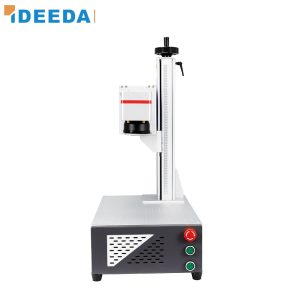
| Desktop / Benchtop | Compact, manual Z-axis, no enclosure | Baseline |
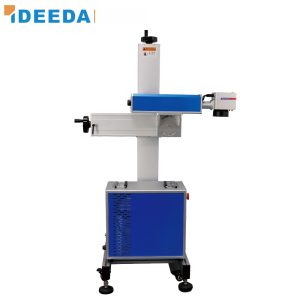
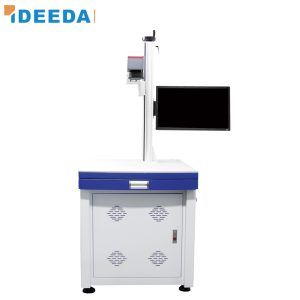
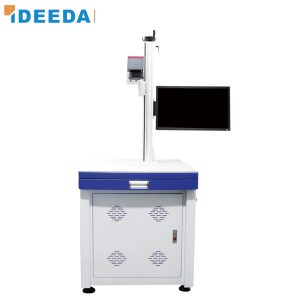
| Standalone Cabinet | Enclosed, motorized Z, safety interlock | +$1,000–$3,000 |
| Conveyor Integration | Pass-through for inline marking | +$2,000–$5,000 |
| Robot/Multi-axis | Automated part handling, rotary, vision | +$5,000–$20,000 |
Factor 5: Country of Origin and Brand Premium
| Origin | Price Characteristic |
|---|---|
| China (domestic brands) | Lowest prices, rapidly improving quality, variable support |
| China (export-oriented) | 20–40% premium over domestic for better QC and support |
| Taiwan/Korea | 30–60% premium, good quality-to-price ratio |
| Europe (TRUMPF, Trotec, FOBA) | 3–8x Chinese pricing, premium support, established brands |
| USA (TYKMA, Telesis) | 3–6x Chinese pricing, strong domestic support |
Factor 6: Software and Controller
- Basic EZCAD2 system: Included (budget machines)
- EZCAD3 with 3D support: +$500–$1,500
- SAMLight or similar premium software: +$2,000–$5,000
- Vision system integration: +$1,000–$4,000
- MES/ERP connectivity: +$500–$3,000
Factor 7: Accessories
| Accessory | Typical Cost |
|---|---|
| Rotary attachment | $200–$600 |
| Fume extractor | $200–$1,500 |
| Chiller (for 50W+) | $300–$1,000 |
| Additional F-theta lens | $200–$800 |
| Laptop/control PC | $300–$800 |
| Custom jig/fixture | $100–$500+ |